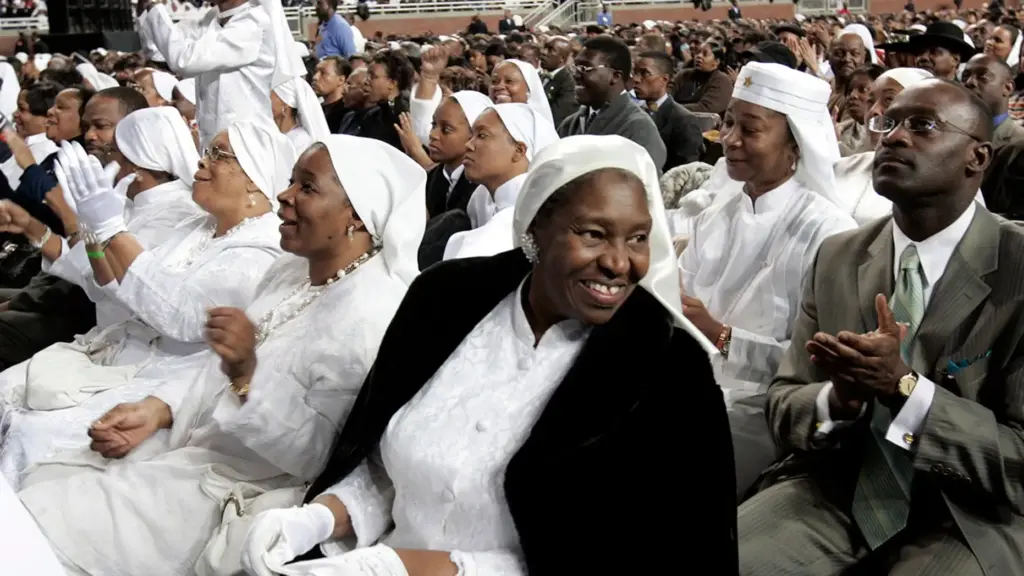

A Detroit-born new religious movement whose founder declared himself the “Black God of the Aquarian Age.”
The Universal Hagar’s Spiritual Church (UHSC) is a syncretic new religious movement and spiritualist denomination rooted in the African American community. Founded in Detroit, Michigan, on September 23, 1923, the church blends elements of Christianity, Spiritualism, Voodoo, Ethiopianism, astrology, and esoteric philosophy into a singular religious tradition. At its peak under its founder, it was described by scholars as the largest black Spiritual church in the United States.
Origins and Founder
George Willie Hurley, the founder of Universal Hagar’s Spiritual Church, was born on February 17, 1884, in rural Georgia near the town of Reynolds. He was raised as a Baptist by his mother, Tina Hurley. At the age of seven he began to preach and challenge the traditional Baptist doctrine, and he was ordained at the age of 11. After high school he went to Tuskegee Institute and Phelps Bible Hall Training School to receive ministerial training.
In 1918–19, Reverend Hurley met Father Elias D. Smith, founder of the Triumph the Church and Kingdom of God in Christ. Hurley was moved by Father Smith and his teachings and consequently joined. After several years, he reached the level of Elder and the presiding Prince of Michigan, but became dissatisfied with the teachings of the Triumph Church. After this he briefly joined the International Spiritual Church, but again he was not completely content.
Father Hurley declared that God “showed him the U.H.S.C. in the form of a brown-skinned damsel and said unto him, ‘this is your wife, take care of her.'” Acting on this vision, Hurley established the church in the Black Bottom neighborhood on Columbia Street near St. Antoine on September 23, 1923. He founded the church “for many reasons,” mainly that of “aiding drifting humanity.”
Beliefs and Theology
The theological framework of the Universal Hagar’s Spiritual Church was highly eclectic and evolved considerably over Hurley’s lifetime. Like other spiritual churches — “spiritual” being the name adopted by Spiritualism in the Black community — the UHSC altered traditional Spiritualism by blending Catholic ritual, Holiness preaching, and elements of folk magic culture or Voudou. Hurley also drew upon Ethiopianism, a belief that identified Black people (Ethiopians) with the ancient Israelites; astrology; and insights from The Aquarian Gospel of Jesus Christ, a channeled book that purports to tell of Jesus’ lost years.
Among the most striking of Hurley’s theological claims was his doctrine of astrological succession. Just as Adam had been the God of the Taurian Age, Abraham the God of the Arian Age, and Jesus the God of the Piscean Age, Hurley preached that he was born to be God of the Aquarian Age — a period of peace and social harmony. He believed that the Aquarian Age had begun with the signing of the armistice following World War I, that it would last 7,000 years, and that it would see the end of Protestantism, segregation, and injustice. By around 1933, he told his followers that his carnal flesh had been transformed into the flesh of Christ and that he had become the “God” of this Aquarian Age, just as Jesus had been the God of the previous Piscean Age. Hurley even called himself the “Black God of the Aquarian Age.”
Along with his traditional Spiritualist ideals, Hurley taught a form of Black Judaism. He believed that Blacks were God’s original Hebrew people and that the mark of Cain — God’s curse — was the pale skin of white people. At times, his writings suggest that the Aquarian Age will be one of Black dominance. Although he was a virulent critic of racism, he rejected intermarriage between Blacks and whites.
Hurley also went through what scholars have described as a brief but notable “Islamic phase.” In 1930, he published a pamphlet entitled “Arabian Science” under the pen name Aboonah Adam, in order to promote linguistic competence among his followers. He hoped this would increase freedom for “American ‘Ethiopians,'” who he felt were held back due to lacking a mastery of the English language. His “Islamic phase,” however, was brief. He seemed to absorb Islam and Arabic into his heterogeneous Spiritualist practice, as he had so many other dogmas, and kept moving.
Institutional Structure and Schools
In 1924, Hurley established the School of Mediumship and Psychology, and as new congregations developed, each also had a school attached to it. Hurley conceived of the school as a branch of the Great School of the Prophets, which he believed to be the school Jesus attended during the 18 years between his appearance in the temple in Jerusalem and the beginning of his public ministry at the age of 30.
In 1934, Hurley also established the Knights of the All Seeing Eye, a Masonic-like auxiliary open to both men and women. This was a tactical move on his part, as he was losing members to Masonic organizations and wanted to find a way to retain his parishioners. The group used fezzes as ceremonial regalia, and its symbols drew on esoteric iconography.
Hurley welcomed women to the ministry, and they have always been well represented on the Wiseman’s Board, the church’s ruling structure. State directors are called princes, a term taken over from Triumph the Church and Kingdom of God in Christ.
Practices and Daily Life
Members of the Universal Hagar’s Spiritual Church, sometimes referred to as Hurleyites, maintain a set of distinctive daily practices and dietary restrictions. Members observe certain strict dietary prohibitions, including abstinence from pork, black tea, coffee, and tobacco. Conversely, the consumption of alcoholic beverages, which are sometimes served at church banquets, is permissible in moderation. Members also drink a variety of herbal teas, including a special blend called “Father Hurley tea.”
Members of the church direct their prayers, petitions for help and guidance, and hymns before images of their God, as well as to Mother Hurley, his spouse, and other “patriarchs” and “prophets” who are now in the spirit world. Services incorporate trance states, spirit-led teachings, spiritual readings, healing services, and rituals intended to cleanse individuals from negative energies.
Growth and Expansion
Unlike many spiritual leaders, Hurley took a strong stand on social issues and was an early supporter of Franklin D. Roosevelt. The church planted congregations across the Northeast and Midwest during Hurley’s lifetime. At the time of his death in 1943, the Universal Hagar’s Spiritual Church had come to include at least thirty-seven congregations — eight in Michigan, eight in Ohio, six in Pennsylvania, seven in New Jersey, and additional outposts in other northeastern and midwestern states.
Leadership After Hurley
George Willie Hurley died on June 23, 1943. Since Hurley’s death, the UHSC has been led by Prince Thomas Surbacher, Mother Mary Hatchett, Prince Alfred Bailey, and Rev. G. Latimer, Hurley’s daughter. Prince Alfred Bailey of New York became the fourth President of the Universal Hagar’s Spiritual Association after Mother Hatchett’s death in 1977. In 1980, Prince Bailey passed and Princess Georgia Latimer of Michigan, the fourth child of Father and Mother Hurley, became the President. Princess Ida Lee Childs of Ohio took the reins in 1994 after Princess Latimer’s death. Princess Childs appointed Princess Shirley Aquart of New Jersey as Acting President in April 2005. Princess Aquart was subsequently elevated to full President following Princess Childs’ death in 2007.
In 2012, the UHSCA boasted over 30 temples and missions in 14 states — Michigan, Ohio, Illinois, Indiana, New York, New Jersey, Pennsylvania, Connecticut, Wisconsin, Maryland, Virginia, South Carolina, Georgia, and Alabama — and was headquartered at 555 South Oakwood Blvd., Detroit, Michigan.
In 2009, the Hagar’s School of Ministry (HSM) was established under the commission of the President of the Wisemen Board to train men and women for ministry. The HSM operates as a distance learning program for ministerial training and development, offering education in ministry, biblical knowledge, leadership, social responsibility, and personal and spiritual development.
The church’s records from 1925 to 2014 are held at the University of Michigan’s Bentley Historical Library, making it one of the few new religious movements of its kind with formally archived institutional records available for scholarly study.
References:
https://www.encyclopedia.com/science/encyclopedias-almanacs-transcripts-and-maps/hurley-george-willie-1884-1943
https://www.encyclopedia.com/science/encyclopedias-almanacs-transcripts-and-maps/universal-hagars-spiritual-church-uhsc
https://findingaids.lib.umich.edu/catalog/umich-bhl-2012055
https://www.nailhed.com/2014/09/black-white.html
http://what-when-how.com/religious-movements/universal-hagars-spiritual-church-religious-movement/
https://fezmuseum.com/religious-groups/
https://www.uhscaseminary.org/about
image via uhsca.org