
A Kenyan man who claims to be the second coming of Jesus Christ, whose mud-walled compound a small village in Bungoma became the biblical Jerusalem.
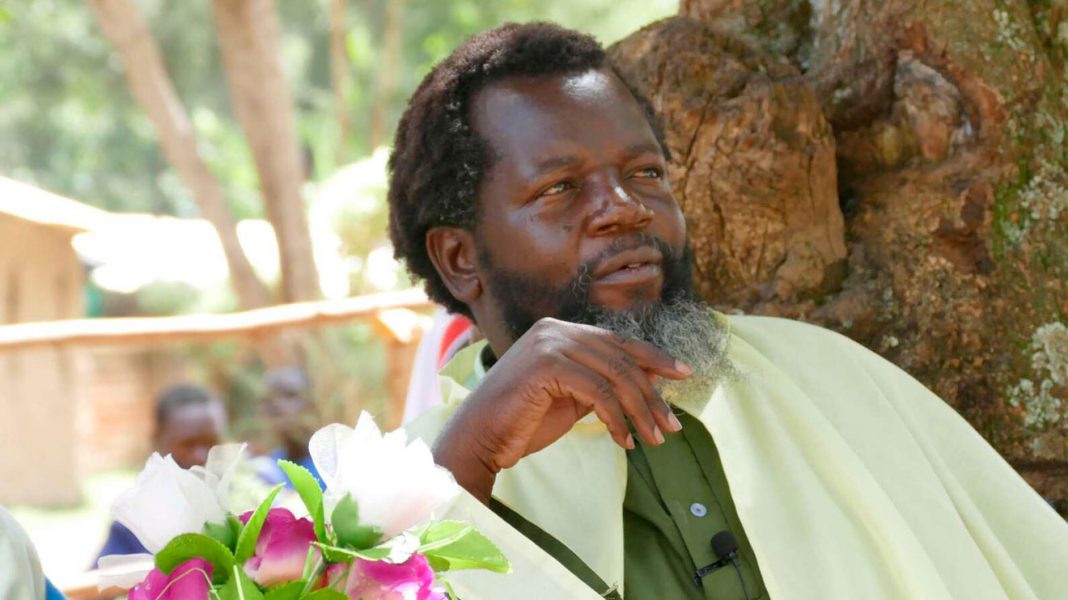
Eliud Wekesa Simiyu, popularly known as “Yesu wa Tongaren” (Jesus of Tongaren), is the founder and leader of the New Jerusalem Church (TNJC), a new religious movement based in Lukhokwe village, Tongaren sub-county, Bungoma County, in western Kenya. Operating since 2011, the group has attracted hundreds of followers and significant national media attention, and has been the subject of multiple police investigations and academic studies. The movement is sometimes classified as a cult by Kenyan authorities and press.
Wekesa was born in 1981 in Tongaren, Bungoma County. His parents, Francis and Cecilia Simiyu, died when he was a boy. He was born a Catholic and attended Mukuyu Primary School in Tongaren, Bungoma County. Wekesa dropped out of school while in Form One at Mukuyu Secondary School and became a farmer, then married at age 20 in 2001 and became a father of eight.
The origin of Wekesa’s religious calling is attributed to a traumatic injury. According to his neighbours, in 2009, he was struck in the head during a family dispute and taken to the hospital for treatment. Following his release from the hospital, he began preaching, and started asserting himself to be Jesus, claiming miraculous abilities ever since he announced himself as a divine being. He spent a great deal of time studying the Bible after receiving what he described as his divine calling, focusing on the teachings of the Old Testament. Speaking in tongues, meditations, dreams, and intercessory prayer were all incorporated into the community’s worship.
The New Jerusalem Church of Tongaren emerged in 2011. Wekesa is known by several names across different reports, including Eliud Simiyu, Eliud Wekesa, and Eliud Wekesa Simiyu, and is referred to by followers simply as “Jesus of Tongaren.” He is the supreme leader of the church and is assisted by “human angels” such as Angel Gabriel, Reuben, and Micah. Wekesa holds the sole mandate to baptize new converts and conduct marriages and ordination ceremonies, and has chosen twelve disciples to help him run his church. His wife holds the title of “Queen” or the “Blessed One” and is counted as the twelfth disciple. The twelve disciples are named after the descendants of the biblical Jacob.
The TNJC’s hierarchy is structured with God the Father at its head, followed by the Holy Spirit, then Jesus of Tongaren, angelic beings, disciples, pastors, and deacons. Wekesa is explicit about why he occupies this position. He has stated: “I am the son of God and I came back to complete the work that I started more than 2,000 years ago. I have come for the second time to save those who await me, not to die for their sins since the Bible does not speak about a second crucifixion.” He additionally justifies his married life by claiming that the Isaiah-prophesied Jesus was supposed to marry and have a family.
A central pillar of New Jerusalem belief is that Lukhokwe village in Tongaren is the literal biblical Jerusalem. He recounts how it was revealed to him through numerous visions from angels that he was the true son of God who had returned to earth to take his people home, and he insists that Lukhokwe village is the New Jerusalem. According to Wekesa, God showed visions to three of his sect members indicating that God Himself would be visiting “Jerusalem” from February 24 to 26, 2023.
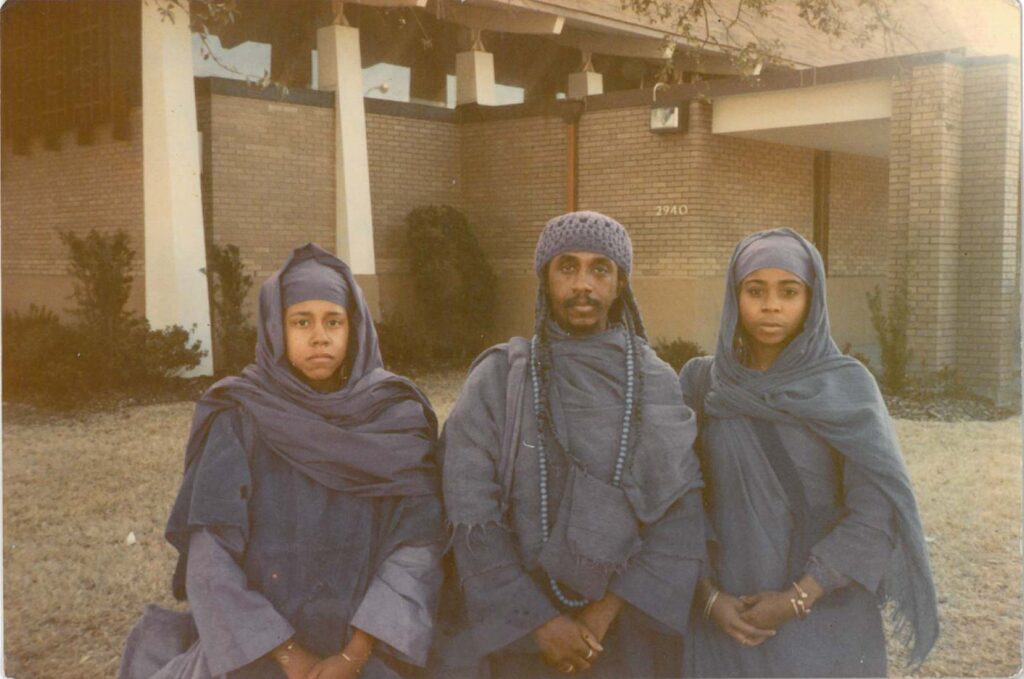
The role of dreams and visions in the life of the community cannot be overstated. Sect members believe their visions and dreams are true revelations from God that must be acted upon. This extends even to matters of clothing. The colour and design of the clothes members wear during worship are not uniform but are instead dictated by the individual visions and dreams each member receives. However, broad restrictions still apply: women who wear trousers, makeup, rings, or wigs are declared by Wekesa to already bear the mark of the beast, and men are forbidden from wearing mohawks, which are similarly regarded as the mark of the beast.
The dreams and visions members receive are recorded by a woman named Rachel in a black book. She documents visions revealed to members or their leader, as well as the names and questions posed by journalists and the answers given by Jesus of Tongaren. She also records news items about the leader that appear in media. These records will eventually be compiled into a new scripture called the “Agano Jipya Safi,” or “Pure New Testament.”
Every member of the New Jerusalem sect is referred to as an angel or prophet and is prohibited from using their official names as they appear on their national identification cards. The naming of prophets and angels in the church does not conform to the Bible or gender. It is based on revelations that the would-be prophets themselves claim to have received, which means there are women prophets who bear male names.
The physical layout of the compound reflects the theology of the group. When sect members come to Jerusalem, they must first pass through a cleansing hut to repent their sins. According to Wekesa, God requires people to repent before entering the temple. There is, however, no water in the cleansing hut, as the sect regards cleansing as a spiritual rather than a physical act. Inside the church, strict behavioral rules govern worship. Wekesa sits at the front of the church with his wife beside him, along with his eleven other disciples. Any worshipper is required to address Jesus of Tongaren as “The Holy One” three times before saying anything inside the church.
Menstruating women are subject to particularly strict rules. Women on their periods wear black attire and sit at the back of the church. They are not allowed to stand, talk, or shake hands with fellow worshippers. The sect cites the Book of Leviticus 15:19 as justification for this practice. The compound has three kitchens: one used by women on their periods, one for other worshippers, and a third that remains under lock and key, reserved for cooking food for Jesus of Tongaren and his family, accessible only to two designated individuals.
Fasting practices within the movement are notably severe. Worshippers who fast for three days are not allowed to drink or eat anything. Those who fast for seven days are allowed to drink only one glass of water every evening. Those who fast for forty days are required to drink only one cup of black tea daily but are prohibited from consuming water or eating food.
The sect holds three festivals each year, at New Year, in July, and in October, each celebrated for three days, during which goats, sheep, and cows are slaughtered. Members of the church worship on two days: Saturday and Sunday.
Wekesa has made a number of specific and striking prophetic claims. He has prophesied that only 168,000 people worldwide will enter heaven, and that only two residents of Nairobi would qualify, neither of whom had yet been born. Regarding miracles, his wife, who goes by the name Prophet Benjamin, has claimed that her husband converted water into a large amount of tea that was enjoyed by villagers, some of whom took it home. She has also claimed that he has the power to heal the sick.
Followers of the group have recounted personal testimonies of what they describe as miraculous interventions. One church member, Nabii Pesai, who joined in 2011, recounted that her husband had been a habitual drunk, and that she had a two-and-a-half-year-old child who could neither walk nor speak. After seeking help through Wekesa’s ministry, she said her child began to walk and speak after a single session of prayer, and her husband was converted and became a preacher.
One area where the group has attracted repeated official concern is its stance on medicine. Wekesa has run afoul of the law for his teachings on this subject and has been arrested several times. In 2011, police arrived at his compound in four vehicles and charged him with discouraging people from seeking medical care and preventing their children from going to school. He was held in a Bungoma police cell for 16 days. In 2021, Wekesa publicly participated in a government mass drug administration campaign targeting bilharzia and intestinal parasitic worms in Bungoma County, swallowing his medication in public, raising hopes he might encourage his followers to seek medical care. However, a community health promoter working in the area reported that resistance to medical interventions, particularly among his church members, remained persistent.
Wekesa was drawn into national scrutiny again in 2023 in connection with the Shakahola massacre, in which followers of Paul Mackenzie, leader of the Good News International Church in Kilifi County, were found to have starved to death in mass numbers in what Mackenzie claimed was preparation for meeting God. As investigators exhumed more than 130 bodies in Kilifi County during May 2023, Wekesa was summoned by police in Bungoma for questioning about his own religious teachings and activities. Bungoma Police Commander Francis Kooli stated that the questioning was in the public interest and aimed at establishing whether the teachings of Wekesa and others were within the limits of the law, with the goal of protecting the public from harm.
Wekesa was accused of running a religious cult in Tongaren, purporting to be Jesus Christ, teaching radical ideologies to his followers, some of whom were minors, as well as practising and promoting money laundering. According to a supporting affidavit submitted by the investigating officer, charges against him included radicalisation, money laundering, acquisition or possession of proceeds of crime, managing an unlawful society, and writing or uttering words with intent to wound religious feelings, contrary to Section 138 of the Penal Code.
A court in Bungoma County ordered him held for four more days to allow a mental health evaluation. The Bungoma County director of criminal investigations stated in a sworn affidavit that Wekesa had refused to undergo the psychiatric assessment. His lawyer, Wamalwa Simiyu, objected to the request, arguing that the police had arrested and arraigned his client without proper investigations and that Wekesa had been running his church with the full knowledge of the police, who had not previously raised concerns. The lawyer additionally argued that the police were attempting to link his church to the Shakahola deaths without evidence.
The Kenya Atheist Society also called for his release, with its president stating that the society did not see anything cultic about Wekesa’s practices and that the police were being overzealous in arresting him.
After spending five days in police custody, Bungoma Principal Magistrate Tom Olando released Wekesa after the State reported it had failed to provide sufficient evidence. One of Kenya’s 2022 presidential candidates, Professor George Wajackoyah, appeared in court on his behalf and argued that the arrest was politically motivated and that every religious leader had a constitutional right to preach. The Office of the Director of Public Prosecution informed the court that the state had decided to close the file. The magistrate further ordered police not to interfere with Wekesa’s activities in Tongaren.
Earlier in 2023, Wekesa had also attracted public attention around Easter, when sections of the Kenyan public began circulating claims and commentary online suggesting he should be crucified to test whether he would resurrect, in keeping with the scriptures he claims to embody. Wekesa responded by saying that God had revealed to him that any assailants attempting to lay him on the cross would be overcome with deep sleep.
The movement exists within a broader phenomenon in the Bukusu sub-tribe of the Luhya people of western Kenya, a region that has historically produced a number of figures who have claimed divine identity. These include Jehovah Wanyonyi, who claimed to be God himself and died in 2015, and Nabii Yohana, who claims to be the reincarnation of John the Baptist. Scholars and observers have noted that high levels of poverty and low literacy rates are characteristic among the most devoted followers of these movements.
References
- Daily Nation — Bungoma ‘Jesus’: Only two Nairobi residents will make it to heaven (February 3, 2023)
- Daily Nation — ‘Yesu wa Tongaren’ breaks silence on Easter crucifixion plot (March 6, 2023)
- Daily Nation — ‘Yesu wa Tongaren’ spends night in cell as cult probe continues (May 12, 2023)
- Daily Nation — Court allows police to hold ‘Yesu wa Tongaren’ for 4 more days (May 13, 2023)
- Citizen Digital — Court orders ‘Yesu Wa Tongaren’ be detained for 4 days at Bungoma Police Station (May 2023)
- Nairobi Wire — Wajackoyah secures freedom for ‘Yesu wa Tongaren’ (May 17, 2023)
- Pindula News — Kenyan Court Orders Police To Release Preacher “Yesu wa Tongaren” (May 20, 2023)
- The Standard — The gods of western Kenya: Spiritual liberation or dementia? (February 2023)
- The Standard — Why Bungoma is home to largest number of ‘gods, angels, prophets’ (April 2023)
- TNX Africa — Mungu wa Kakamega, Yesu wa Tongaren, Jehovah Wanyonyi: Rise of deities in Western Kenya (June 2025)
- Tuko.co.ke — Yesu Wa Tongaren: Kenyan Atheists Demand Bungoma Preacher Freed (May 2023)
- Newsday Zimbabwe — Kenyan ‘Jesus’ summoned in crackdown on cults (May 2023)
- NTV Kenya — ‘Yesu wa Tongaren’ grilled by Bungoma police commander (May 2023)
- Global Health Now — The Push to Get Kenyan Cult Leaders to Embrace Modern Medicine (April 2024)
- ResearchGate — Anatomy of Beliefs and Practices of the New Jerusalem Church of Tongaren, Kenya — Ng’etich, B. K. (2024). Journal of African Interdisciplinary Studies, 8(5), 57–106
image via OpIndia