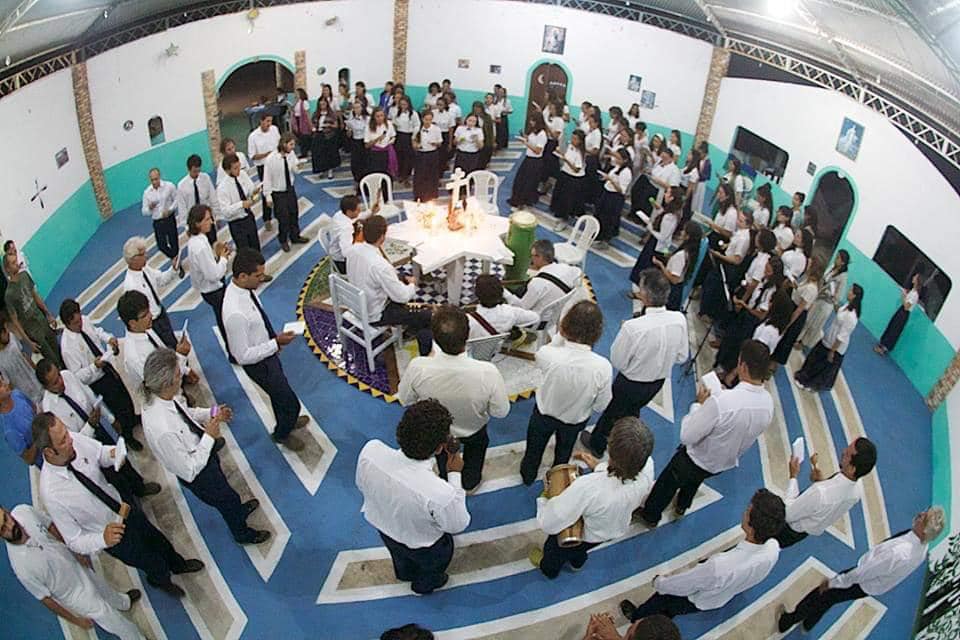

A Brazilian spiritual movement centered around folk religions and the ritual use of Ayahuasca
Religion: Christianity
Denomination: Ayahuasca-based syncretic religion
Founder: Raimundo Irineu Serra
Founded: 1930s
Location: Brazil
Size: Several thousand members globally
Other Names: Doctrine of the Divine Love, Céu do Mapiá, Céu do Juruá
Website: santo-daime.org
Santo Daime is a syncretic spiritual movement originating in the Brazilian Amazonian state of Acre during the 1930s, founded by Raimundo Irineu Serra, an immigrant from Brazil’s northeast. This new religious movement incorporates elements from Folk Catholicism, Kardecist Spiritism, African animism, and South American shamanism, distinguishing itself through the ritualistic consumption of Ayahuasca, known within the movement as Daime. Ayahuasca, a psychoactive brew, plays a central role in Santo Daime’s religious practices, facilitating communal ceremonies that include singing hymns, dancing, and meditative practices aimed at personal and spiritual purification and enlightenment.
The origins of Santo Daime trace back to Serra’s profound spiritual experiences after consuming Ayahuasca in the early 20th century, which led him to establish a doctrine based on the visions he received. These visions inspired a set of practices and teachings emphasizing harmony, love, truth, justice, and personal growth through spiritual work. Santo Daime’s rituals are characterized by their devotional nature, with ceremonies that incorporate Christian prayers, the singing of hymns (hinários), and sometimes silent meditation or dance. The practice encourages introspection and spiritual communion, aiming to connect participants with divine principles and the natural world. The Cross of Caravacca, a symbol with a double horizontal beam, and other elements like the sun, moon, stars, and the hummingbird (beija-flor) are significant within Santo Daime’s iconography, reflecting its eclectic blend of religious and spiritual influences.
A key aspect of Santo Daime’s belief system is the concept of spiritual learning and purification through the Ayahuasca experience, which is thought to reveal both positive aspects and unresolved issues within oneself. This process of self-discovery and spiritual work is central to the movement, with the effects of Daime requiring participants to develop stamina and firmness (firmeza) during the often extensive ceremonies, sometimes lasting up to 12 hours.
The hymns sung during Santo Daime ceremonies are of paramount importance, believed to establish a direct connection to the spiritual and divine realms. These hymns, received through spiritual inspiration, convey the teachings and essence of Santo Daime’s doctrine, facilitating healing, strength, and spiritual communion among participants. The tradition also respects the diversity of its global community, with members sometimes receiving hymns in their native languages, highlighting the universal appeal and adaptability of Santo Daime’s spiritual practices.
Following the death of Mestre Irineu in 1971, Santo Daime experienced diversification, leading to the establishment of different branches within the movement. This includes the significant shift led by Sebastiao Mota de Melo, who formed CEFLURIS, a group that differed in certain doctrinal aspects, including the use of cannabis in ceremonies. Despite these variations, Santo Daime has continued to expand internationally, with communities in North America, Europe, Japan, and beyond, underscoring its role as a global spiritual movement.
The legal status of Ayahuasca, and by extension Santo Daime’s religious practices, has been a subject of legal scrutiny and debate. In Brazil, the use of Ayahuasca for religious purposes has been legal since 1986. However, the international legal landscape is varied, with recent legal victories in countries like Holland and Spain, while in the United States, the Supreme Court has recognized the religious use of Ayahuasca for specific groups, underscoring ongoing discussions about religious freedom and psychoactive substances.
Santo Daime’s blend of Christian elements, indigenous spirituality, and a focus on personal growth through the Ayahuasca experience highlights its unique place within the spectrum of new religious movements. Its emphasis on living a life aligned with divine principles, the importance of community, and the integration of spiritual teachings through music and ritual, continues to attract followers worldwide, seeking a path of spiritual development and enlightenment.
image via Chacruna